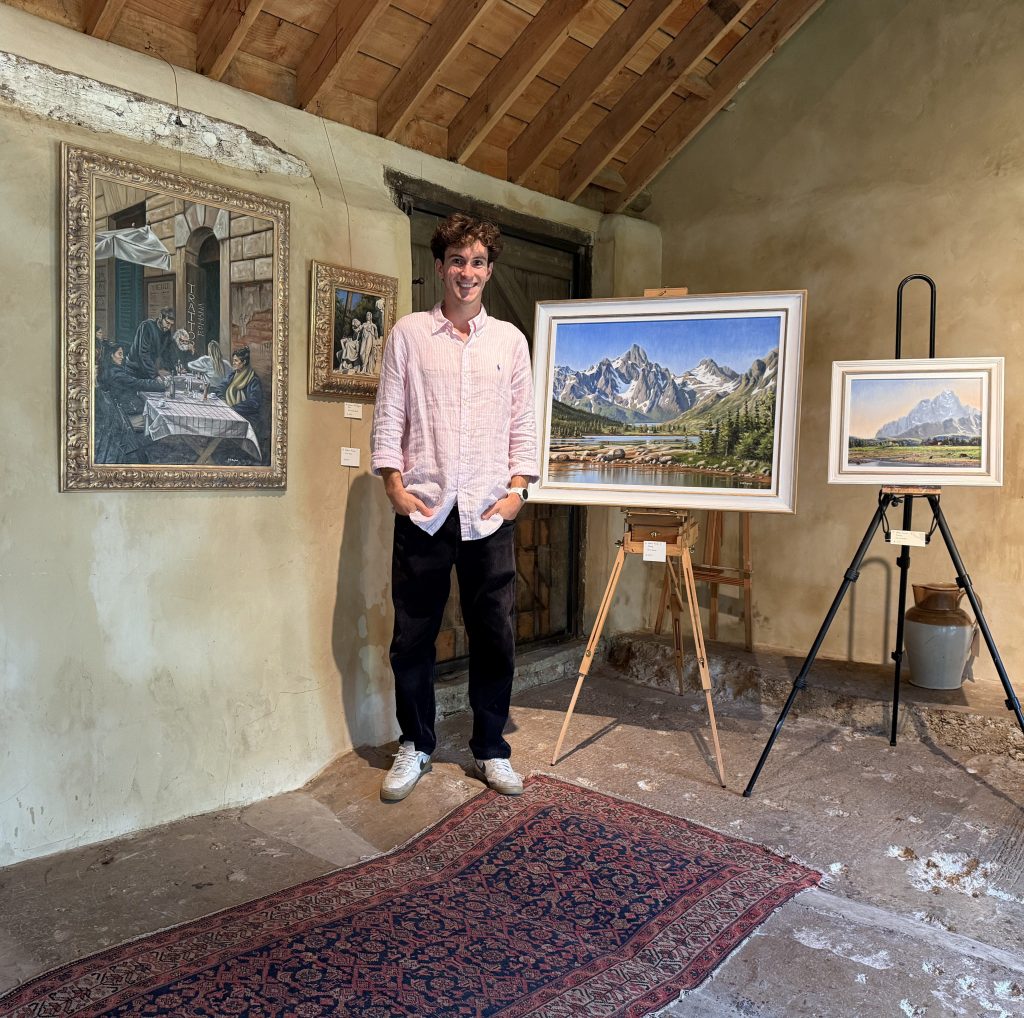
I am a 24 year old fine artist and aspiring clinical psychologist based near London. I believe these dual interests, rather than being independent, are mutually informative. It is my hope that my art feels psychological; and my understanding of psychology, mental health, and the mind is underscored by my belief in the power of art, story, and narrative to explore our lives, the social roles we occupy, the relationships we partake in, the patterns of behaviour and cognition we developed in response to the trauma we experienced.
I completed my BSc in psychology at the University of Edinburgh in the summer of 2024. Immediately after graduating I spent a year in Japan working as an English teacher. The relationships I developed and experiences I had in this time significantly shaped my outlook on life and artistic direction. After three months in Rome on a study abroad, I am now working at a Pupil Referral Unit with therapeutic provision, and will be starting an MSc degree in Clinical Mental Health Sciences at UCL in September. My September 2026 Exhibition, Rituals and Portals, is being held to raise money for tuition fees. Throughout this journey in psychology, art has remained what I always return to for an understanding of myself and the world.
Exhibitions and awards
2026 – Exhibition – Solo Exhibition, Rituals and Portals
2026 – Exhibition – piece in Chelsea Art Society, Summer Exhibition
2026 – Award – Chelsea Art Society Summer Exhibition Award to be featured in Artists and Illustrators magazine
On Art
I see art as the interface between mind and reality. It is the way we understand, and in some ways simplify, those visceral facets of human life, so prodigiously complex and elusive of rationality. I say simplify not to depreciate the potency of art, but rather to highlight the importance of an artistic sensibility to bypass some of the cerebral and analytical thinking that permeates so much of the rest of life.
Nevertheless, it is a not infrequent exercise to attempt to delineate the boundaries of art, or provide a “rational” definition. I believe this entirely misses the point. Any attempt to categorise or evaluate artistic expression is inherently detractive as it strips the art of its emotional resonance, its romance, its heartbreak, its serenity, its torment, its beauty. If this is dissolved, what is left?
It is why we read poetry at weddings and funerals, why we look at paintings to be transported in place and time, why we read novels to explore the narratives we embody, why we listen to music to feel emotion and why we watch film to be immersed in other worlds.
Art, then, is how we feel – both how we express this feeling and how we give it meaning. As someone pursuing a career concurrently in art and clinical psychology, this question of meaning is acutely beguiling. In a world of such cheap distraction, a relenting to the sort of numbing hedonism that is currently so prevalent leaves an emptiness which is at the root of so much mental suffering.
As psychology edges closer towards that of the natural sciences in its philosophy and application, psychology and art might be construed as existing on opposite ends of an analytical – creative spectrum. I believe it is for this very reason that art, be it visual art, music or literature, has the potential to be so powerful in the psychology professions.
In the modern climate of medicalisation of mental health – assessment, diagnosis, medication – what has stayed inherent to the human condition is the desire to make meaning of our suffering by telling stories and making art, thus transcending some of the absurdity of existence by instilling life with beauty and purpose.
The practice of psychology and psychiatry can be guilty of overlooking this fundamental drive. The rejection of this approach for a more medical model focused on classification and cure quietly dissolves our ability to embody or integrate the meaning that we derive from the narratives we tell about our lives and what has happened to us. It reorients the focus of psychological therapy towards treatment of a disease akin to a malignant growth you wish to banish, rather than a more compassionate focus on the person which would incorporate an integration of life events, trauma and personal narratives into a more holistic and individuated identity.
I believe art, story, conversation, the pursuit of meaning, are irrevocably entangled in this journey of creating a more narrative understanding of mental health. It is an iterative process rather than a direct cure, reflected in the perennial adventure of what it means to go through the process of making or appreciating art. Because it is always a process:
“The end of a melody is not its goal” – Nietzsche
I believe this process is always more enlightening when shared. Whether it is shared in conversation, activity, or simply in mutual presence, these are the rituals we collectively partake in which ground our sense of purpose. Art, then, in all its forms, is a shared portal to a more visceral understanding of the world, allowing us to see how beautiful it can be.
“Through the eyes of a real friendship an individual is larger than their everyday actions” – David Whyte
Oscar Wilde famously remarked “all art is quite useless”, a condemnation of the moral, political or social utility of art in celebration of its inherent beauty as its sole purpose; or “art for art’s sake”. Beauty, however, or the ability to permeate life with beauty, might instead be the most useful pursuit of all.

